Friday, July 15, 2005

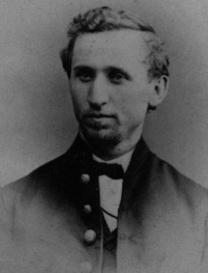
Photo of Richard Lewis in Civil War Uniform?

One of the photographs we have of Richard Lewis shows a young man in a dark coat with a high collar and large round buttons. This looks very similar to the uniform worn by enlisted men in the Signal Corps during the Civil War.
Young Richard Lewis

Civil War photos for comparison (links open in a new window):
Signal Corps Enlisted Uniform
Signal Corps men at Washington, D.C. Central Signal Station
Photo of Henry Sherriff from the Gettysburg Camp Life Exhibit

Of course it's possible that this was simply the fashion in the 1860s. Comments?

Earlier posts about Richard Lewis in the 2nd Pennsylvania Heavy Artillery and the Signal Corps.

Labels: , ,


Read the rest of this post.

Thursday, July 14, 2005

Sarah Betts in York County, PA: living through the Civil War

Sarah Betts was born in 1846 in Baltimore, Maryland, where her father, Edward Betts was a piano maker. In 1859, Edward died in New Freedom, York County, Pennsylvania. What happened to Sarah at that time is unclear.

New Freedom is in the southern Shrewsbury Township, just north of the Maryland border. In 1860 the following household was found in Shrewsbury Township.

NAME_____________________AGE BIRTHPLACE
Henry O. Diffenderfer____63 M Penna farmer
Mary B. Diffenderfer_____47 F Delaware
Sarah Betts _____________13 F Maryland attended school
Lilly Betts ______________6 F Maryland
Nathan Shire (Shise?) ___18 M Penna
Hester A. Smith _________13 F Black Maryland
George Lickner __________10 M Maryland attended school

The age and birthplace is consistent with our Sarah Betts. We have no information as to whether our Sarah had a younger sister Lilly. In 1870 this family (Henry and Mary Diffenderfer with Sarah and Lilly Betts) were living in Manheim Borough, Lancaster County. Our Sarah married Richard Lewis in Mannheim in 1872, so that is again consistent with our ancestor.

York County is on the northern side of the Mason-Dixon Line east of Gettysburg in neighboring Adams County. In June 1863, Confederate troops marched into the city of York, where they met little resistance, and were handed the keys to the city by town fathers.

Many Republican-leaning townspeople at that time and some students of the Civil War today believe that the town’s fathers were too soft. Gen. Jubal Early, in command of the occupying rebel forces, would not have extracted as much from the town if he had met resistance instead of cooperation. The Confederates were under orders not to harm private property. Early was bluffing, and York’s fathers fell for it.

The Confederate cavalry under Jeb Stuart began moving west. On June 30th, the 1500 citizens of Hanover in southwestern York county were overrun by 7500 battling horsemen, when Stuart's troops clashed with the Union Cavalry. This was the first civil war battle to take place in Pennsylvania.

On July 1st Union and Confederate troops converged in Gettysburg, where the battle lasted three days.

How did this effect the residents of York County? It is likely that property and possessions were ransacked by the underequipt troops.
York served as a transportation hub, playing host, often at personal cost, to tens of thousands of soldiers from elsewhere moving to and from battle.

Many county residents did not even take a moment to savor the Yankee victory at Gettysburg. They were too busy gathering food and supplies for the care of the wounded at the battlefield, a short 30 miles away.

York County residents were accustomed to mobilizing in such relief. During the course of the war, volunteers helped nurse more than 14,000 wounded and diseased soldiers back to health at the U.S. military hospital in town.

The experience would have been traumatic for anyone, let alone a teenage girl, as Sarah was in 1863, with her young sister.

Links
Map of Southern York County
Civil War Comes to York County (warning: autmatic audio)
East of Gettysburg (from the York Daily Record)
Lee Marches North
Battle of Hanover
Eyewitness to History: Battle of Gettysburg
Battle fo Gettysburg: the aftermath

Labels: ,


Read the rest of this post.

Richard Lewis in the Civil War: Signal Corps

As described in the previous post, Richard Lewis enlisted as a corporal in an artillery unit in August 1862. On January 12, 1864 Richard transferred to the Signal Corps.

The Signal Corps were in charge of communications, usually using signal flags, torches or lamps to send encrypted messages. They were also involved in setting up temporary telegraph lines in the field. Assignment to the signal corps required successfully passing an examination, followed by special training at Red Hill, Georgetown, D.C. in signaling systems (flags and telegraph) and codes used.

We know little about the details of Richard's service in the Signal Corps. According to one roster, he was assigned to the Department of North Carolina. The Department of North Carolina was part of the Eighteenth Corps. However, we do not know where exactly Richard served while with this unit.

Richard was mustered out on July 1, 1865, 18 months after his transfer to the Signal Corps and after almost 3 years in the army, with the rank of corporal. At that time, he probably returned home to Trevorton.

In 1866 Richard Lewis enrolled in the Polytechnic College of Pennsylvania in Philadelphia. See post here.

Links
Roster of the US ARmy Signal Corps (use your browser's "find" feature to jump to Lewis, Richard)
The Story of the Signal Corps
"A Manual of Signals: For The Use Of Signal Officers In The Field." (Washington DC, 1864)
Civil War Signal Corps and United States Military Telegraph (this is the site of a reenaction group, with lots of historical information about the equipment used by the Signal Corps).
History of the Signal Corps
another History of the Signal Corps in the Civil War (with the signal code)
General History of the Signal Corps

Labels: , ,


Read the rest of this post.

Richard Lewis in the Civil War: 2nd Pennsylvania Heavy Artillery

Our ancestor Richard Lewis emigrated from Wales with his parents in about 1851. They settled in Trevorton, in Northumberland County, Pennsylvania. Ten years later,Richard enlisted to serve his country in the "War Between the States". On August 14, 1862, Richard Lewis enlisted as a Corporal in the independent battery recruited by Captain David Schooley.

At the time of his enlistment, Richard was a 22 year old clerk. He was 5 foot 6 inches tall, with a light complexion, light hair and blue eyes.

On November 24, 1862, Schooley’s Battery was incorporated into Company M, of the Pennsylvania 2nd Heavy Artillery unit of the 112th Volunteers.

"As soon as recruits were received, they were sent to Charles G. Zimmerman's "Diamond Cottage," a pleasure resort in the suburb of Camden, NJ, where a rendezvous camp (Camp Angeroth) was established, and where they were drilled in the 'school of the company'." (Regimental History)

From the training camp. soldiers joined the 2nd Pennsylvania Heavy Artillery units that were defending Washington DC, north of the Potomac River.

For the most part, a soldier's duty in the fortifications consisted of maintaining the existing defense structures and building new ones, constructing roads and performing other fatigue details. Most of this work was tough, physical labor and performed under all weather conditions. When not assigned to fortification detail, the individual batteries would engage in parade drill, gunnery drill, marksmanship, and various inspection routines. In addition, the heavy artillery units also received infantry and bayonet instruction. Overall, however, the general view of battle tested veterans of Washington defense duty was regarded as "soft assignments." (from An Account of a Civil War Regiment)

On January 12, 1864, Richard and several other members of his Company transferred to the Signal Corps. (see next post for more details about the Signal Corps.)

Most of the information in this post is from the pension application file of Richard Lewis, and later, his widow Sarah (Betts) Lewis.

Links
Captain David Schooley
2nd Heavy Artillery Pennsylvania Volunteers, Company M
2nd Pennsylvania Heavy Artillery Regimental History

Labels: , , ,


Read the rest of this post.